Linked List (Data Structure)
Definition
A different implementation of the List ADT, where each instance of a Node represents a single element of the list, and LinkedList will represent the list itself.
Node:
from __future__ import annotations
from dataclasses import dataclass
from typing import Optional


@dataclass
class _Node:
    """A node in a linked list.

    Instance Attributes:
      - item: The data stored in this node.
      - next: The next node in the list, if any.
    """
    item: Any
    next: Optional[_Node] = None  # By default, this node does not link to any other node
LinkedList
class LinkedList:
    """A linked list implementation of the List ADT.
    """
    # Private Instance Attributes:
    #   - _first: The first node in this linked list, or None if this list is empty.
    _first: Optional[_Node]

    def __init__(self) -> None:
        """Initialize an empty linked list.
        """
        self._first = None
Traversal
Traversing a linked list can be done with the following patterns: Early return:
curr = my_linked_list._first   # 1. Initialize curr to the start of the list.
while curr is not None:        # 2. curr is None if we've reached the end of the list.
    ... curr.item ...          # 3. Do something with the current *element*, curr.item.
    curr = curr.next           # 4. "Increment" curr, assigning it to the next node.
Examples:
Getting the $i$th index of a LinkedList:
Early return loop pattern
class LinkedList:
    def __getitem__(self, i: int) -> Any:
        """..."""
        # Version 1
        curr = self._first
        curr_index = 0

        while curr is not None:
            if curr_index == i:
                return curr.item

            curr = curr.next
            curr_index = curr_index + 1

        # If we've reached the end of the list and no item has been returned,
        # the given index is out of bounds.
        raise IndexError
Other version:
class LinkedList:
    def __getitem__(self, i: int) -> Any:
        """... """
        # Version 2
        curr = self._first
        curr_index = 0

        while not (curr is None or curr_index == i):
            curr = curr.next
            curr_index = curr_index + 1

        assert curr is None or curr_index == i
        if curr is None:
            # index is out of bounds
            raise IndexError
        else:
            # curr_index == i, so curr is the node at index i
            return curr.item
assertis used to indicate what we know to be true after the loop ends__getitem__is a special method called automatically by the Python interpreter when we use square bracket notation for sequence indexing/dictionary key lookup.
Mutation
Append
class LinkedList:
    def append(self, item: Any) -> None:
        """..."""
        new_node = _Node(item)

        if self._first is None:
            self._first = new_node
        else:
            curr = self._first
            while curr.next is not None:
                curr = curr.next

            # After the loop, curr is the last node in the LinkedList.
            assert curr is not None and curr.next is None
            curr.next = new_node
with the implementation of ths method, we can now write the initialiser for
LinkedList, albeit an inefficient one:
from typing import Iterable


class LinkedList:
    def __init__(self, items: Iterable) -> None:
        """Initialize a new linked list containing the given items.
        """
        self._first = None
        for item in items:
            self.append(item)
This is $\Theta(n^2)$, and it is possible to do it in $\Theta(n)$
Index-Based Mutation
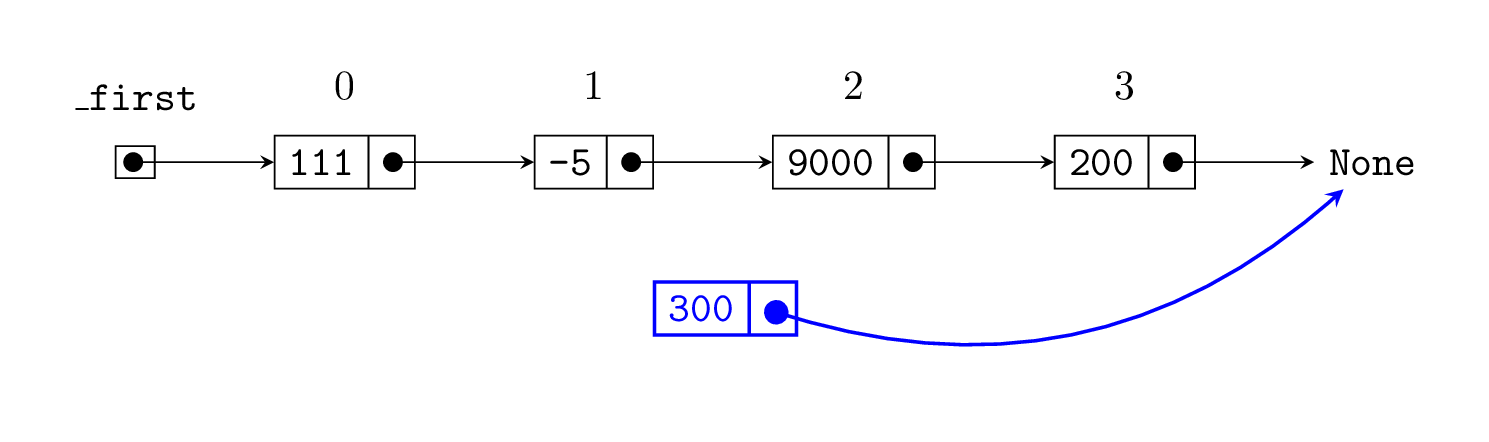
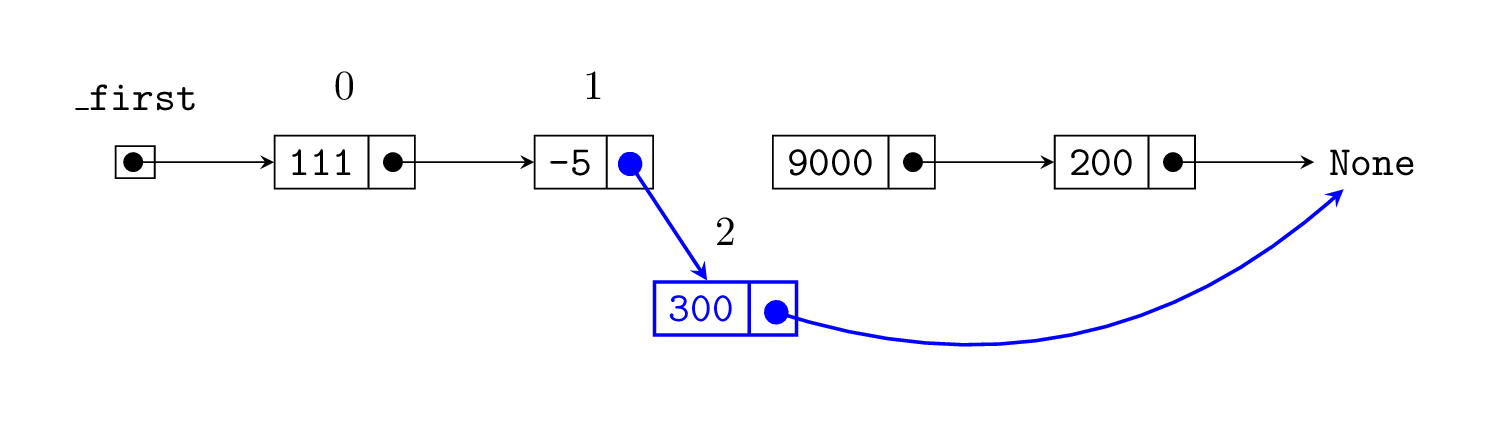
Let's say we want to insert item 300 at index 2
Original list:
 Create a new node (links to None by default):
 Modify links (need to modify index-1 node's link):
 Compound Loop Condition:
class LinkedList:
    def insert(self, i: int, item: Any) -> None:
        """..."""
        new_node = _Node(item)

        curr = self._first
        curr_index = 0

        while not (curr is None or curr_index == i - 1):
            curr = curr.next
            curr_index = curr_index + 1

        # After the loop is over, either we've reached the end of the list
        # or curr is the (i - 1)-th node in the list.
        assert curr is None or curr_index == i - 1

        if curr is None:
            # i - 1 is out of bounds. The item cannot be inserted.
            raise IndexError
        else: # curr_index == i - 1
            # i - 1 is in bounds. Insert the new item.
            new_node.next = curr.next
		curr.next = new_node
Early Return: #todo
Running-Time Analysis
Running time for built-in Python list class:
| Operation (assuming $0 \le i < n$) | Running time |
|---|---|
lst[i] | $\Theta(n)$ |
lst.insert(i, element) | $\Theta(n-i)$ |
lst.remove(i) | $\Theta(n-i)$ |
Insert
Case 1: Assume i==0. The if branch executes, taking constant time. 1 step.
Case 2: Assume i > 0.
- The first two statements take constant time. 1 step.
- Statements after while all take constant time. 1 step.
- The statements iterates until it either reaches the end
curr is Noneor the correct indexcurr_index == i -1- The first case takes $n$ iterations, since
curradvances by one_Nodeeach iteration - The second case takes $i-1$ iterations, since
curr_indexstarts at 0 and increases by 1 each iteration
- The first case takes $n$ iterations, since
Hence, total running time = $1 + \min{(n,i-1)} + 1 = \min{(n,i-1)} + 2$ steps
In the first case, we have a running time of $\Theta(1)$, but in the second case, we have a running time of $\Theta(\min{(n,i)})$. The second case would also be $\Theta(1)$ when $i = 0$
The overall running time of LinkedList.insert is $\Theta(\min{(n,i)})$.
| Operation (assuming $0 \le i < n$) | Running time (list) | Running time (LinkedList) |
|---|---|---|
Indexing (lst[i]) | $\Theta(1)$ | $\Theta(i)$ |
| Insert into index $i$ | $\Theta(n - i)$ | $\Theta(i)$ |
| Remove item at index $i$ | $\Theta(n - i)$ | $\Theta(i)$ |